
Compare Chippewa County Property Value Labels
Chippewa County borrows Michigan's assessment vocabulary. County Equalization reviews city and township rolls for uniformity, while each local assessor sets the individual parcel assessment. The labels are not interchangeable. A sale amount, a mass-appraisal field, and the value exposed to millage answer three different questions, so name the field before making any comparison.
| Value | What It Is | Where |
|---|---|---|
| True cash value | The Michigan concept tied to usual selling price | Local assessment and Equalization framework |
| Assessed value / SEV | Assessment before and after equalization, generally at 50% of true cash value | Local roll, BS&A or FetchGIS |
| Taxable value | The capped or uncapped value to which millage applies | Assessment and tax record |
| Sale or consideration | A reported transfer amount, which may not be an arm's-length market price | Deed, transfer record or portal sale field |
Don't treat a sale price as the new SEV. The county FAQ is explicit on this point. A transaction may be nominal, family-related, estate-driven, or tied to a land contract, which makes it unlike an open-market sale. Whatever property value the record displays, keep its label attached.
Place Chippewa County Equalization in the Value Chain
The Chippewa County Equalization directory describes the office's role. It assists the county board in reviewing assessment rolls for uniformity at true cash value. The review draws on appraisal studies, random class samples, property record cards, field data, and true-cash-value analysis across agricultural, developmental, residential, commercial, industrial, and timber-cutover classes.
Equalization never sets an individual assessment. Its work stays countywide. A parcel's classification, data, correction, or value belongs to the city or township assessor shown on the record. That local step matters. It keeps a Sault Ste. Marie parcel and a rural township parcel from landing at the same office by mistake.
Locate a Chippewa County Assessed Value
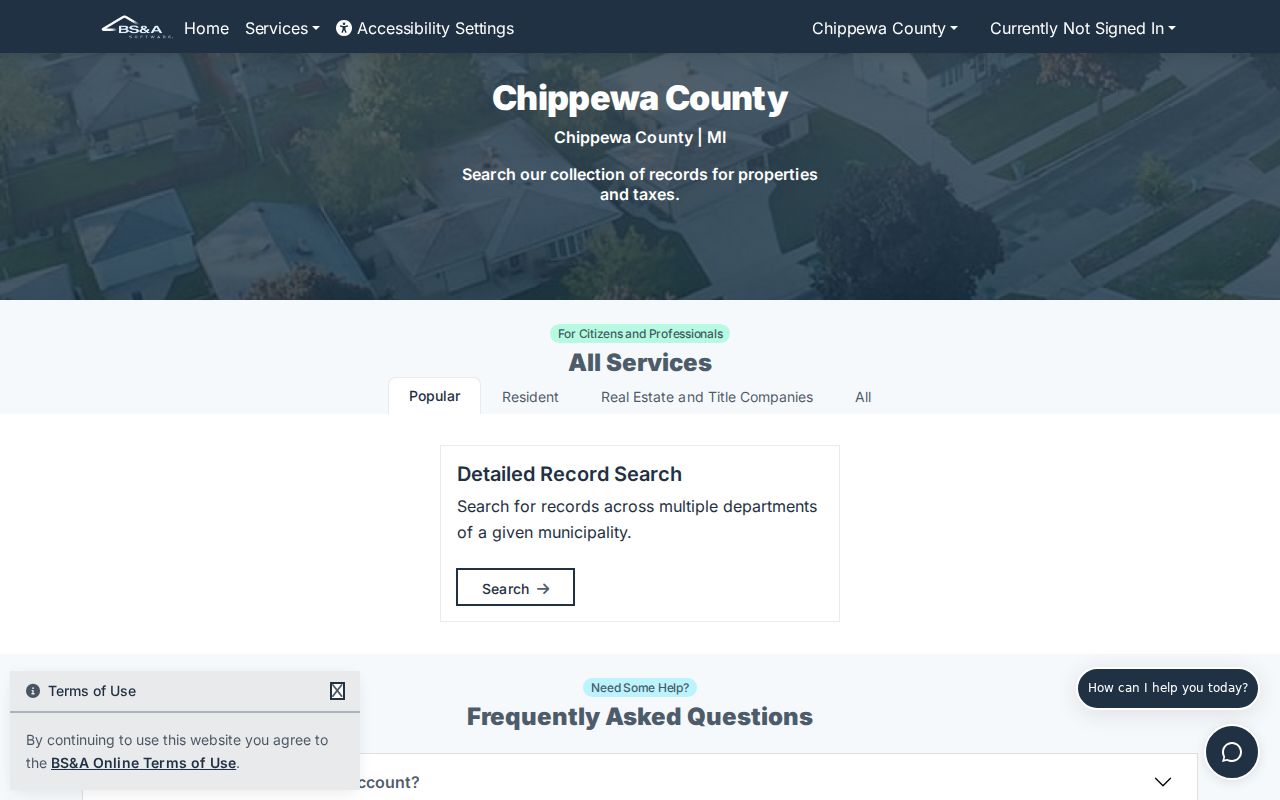
Start a parcel lookup at county BS&A. Keep the municipality and tax year handy. The portal labels each value field on screen, so note what the current display calls assessed, SEV, and taxable value. Matching labels to years prevents false comparisons later.
- Search by address or PIN and verify that the situs, legal description, and municipality identify the intended parcel.
- Save the tax year and the exact assessed, SEV, taxable, and prior-year labels that appear.
- Note transfer date, sale field, PRE or exemption, new construction, and special assessment only where the source displays them.
- Compare any sale amount with the recorded deed or transfer source, without treating it as an appraisal.
- Assessed value
- The parcel's assessment figure before final equalization and statutory limits are applied.
- SEV
- State equalized value, generally 50% of true cash value under the local guidance.
- Taxable value
- The value used with millage to calculate tax and affected by caps and transfer uncapping.
- Reassessment
- The annual process that updates the roll; it is not a private sale appraisal.
Read Chippewa County Value Fields by Year
The county describes BS&A as showing property descriptions, taxable status, owner or taxpayer names, mailing and situs addresses, and tax information. FetchGIS property details add depth. They can carry the current tax year, the prior-year March Board of Review assessed value, final SEV, final taxable value, land data, sales, buildings, delinquent-tax information, and tax history by year and season. Fields shift over time. The official BS&A entry screen shows the live fields. Check it before any parcel comparison.
A blank field proves nothing. It may simply mean the record was left empty. When a missing field affects the conclusion, preserve the empty state and ask the local assessor for the property record card or an explanation.
Note: Save the tax year with every value screenshot; a number without its year cannot support a reliable trend.
Explain Chippewa County Value Changes After Transfer
Taxable value can uncap after a transfer. The county's Equalization FAQ explains the rule. Taxable value then becomes the current SEV. The FAQ also says the actual sale price cannot be the sole basis for that new SEV in the year following a transfer. A jump is not always an error. Compare the transfer date, the old taxable value, next-year taxable value, and SEV first.
A Property Transfer Affidavit is due to the local assessor within 45 days after a non-exempt transfer, even when no deed is recorded. The form collects the PIN, transfer date and price, parties, financing and relationship questions, and exemption claims. Tax records and deeds can move on different clocks.
Audit a Chippewa County Property Value Mismatch
Two values that disagree need context. Build a side-by-side record with year, assessed value, SEV, taxable value, prior-year value, sale date and amount, PRE or exemption, new construction, millage, and special assessments. Local vocabulary does the sorting. Often the mismatch is between unlike fields rather than a data-entry error.
A transfer uncaps taxable value. Construction and exemption changes touch other parts of the record. An assessor sale line can describe an event that is not the latest title instrument. Route factual corrections to the local assessor. The Chippewa County property-tax guide covers the bill and appeal process.
Compare Chippewa County Sale and Consideration Records
Labels matter here too. When BS&A or FetchGIS labels an amount as a sale, keep the label. Keep its date as well. A consideration clause on a deed is recorded consideration. Neither figure is automatically the current market value. Family transfers, trusts, estates, land contracts, foreclosures, and entity changes can yield zero, nominal, omitted, or non-market amounts.
Confirm the transfer through the Register of Deeds when it matters. A sale-history field is a comparison point. The recorded instrument still shows its own parties, description, and terms. A professional appraisal applies a separate method to a defined effective date and purpose.
Choose the Right Chippewa County Assessment Roll
Sault Ste. Marie runs its own city BS&A service, with routes for assessing, property sales, building, tax, special assessments, and detailed records. The city assessor prepares an annual roll. Notices of Assessment go out each February. Check current office arrangements, since the city page records a service transition effective September 1, 2025.
Outside Sault, use county BS&A or FetchGIS to identify the township or village, then call that local assessor. Keep the legal municipality. A postal city name can mislead. County Equalization reviews for uniformity; it is not the source of every parcel decision.
Build a Chippewa County Value Timeline
A value timeline works best when dates anchor every figure. Log the assessment year. Include the prior and current assessed value, the SEV, the taxable value, and the transfer date. Add next-year uncapping and construction. Also add any PRE change, Board of Review action, millage, and any special assessment where they apply. Leave a portal's own year and season labels exactly as shown. Those labels tell you which cycle each number belongs to.
Interpret the shifts carefully. Changes can come from statutory caps, exemptions, corrections, classification, equalization, or improvements. That matters instead of a true market swing. A printed GIS report is also just a dated snapshot. Save the generated date, source URL, parcel PIN, selected layers, and report type. That way anyone can reproduce the trend later.
Note: A change in taxable value does not, by itself, prove a change in title or physical condition.
Know What Chippewa County Property Value Cannot Prove
A Chippewa County assessment record answers a narrow question. It does not prove fee title. And a parcel line on a GIS map is not a surveyed boundary. Likewise, a sale price in the property records may reflect a family transfer. Or it may reflect an arm's-length deal. The county's 50% true-cash-value framework tells you how an assessment relates to true cash value. But it cannot promise that a parcel would fetch twice that figure. Not on any given day, at least.
Use each assessed value for its stated purpose and its own tax year. Need a current market opinion for a sale, estate, loan, or dispute? That calls for a qualified appraiser, not a portal figure. For an exact tax bill, request the official statement from the Treasurer. For delinquency status, ask the local unit instead of an outdated page capture.
Value is not price. A Chippewa County assessed value supports taxation. It is neither a sale prediction nor an independent appraisal of present market value.