
Read Chippewa County's Current Owner Card
Chippewa County posts its assessment data through the BS&A parcel search. Each property record carries an owner or taxpayer field. County guidance adds that the card can include mailing and situs addresses, a property description, taxable status, and tax information. Labels and screens change over time. So the tax year and the label beside the name belong in your notes.
| Owner or taxpayer | The name associated with the selected assessment or tax record, copied with its exact label. |
|---|---|
| Tax year | The period represented by the parcel card and the date context for its current owner name. |
| Mailing address | The address used for tax correspondence; it is not proof of residence or title. |
| Situs address | The physical property address shown in the parcel system. |
| Parcel number | The PIN that links the card to GIS and helps identify the land in other records. |
| Legal or tax description | The parcel description used to compare the assessment record with the deed. |
Assessment data names whoever is carried for taxes. It never proves residency at the situs address. Nor does the mailing line vest title in anyone, so keep each field doing its own job.
View Chippewa County Owner Fields
Start with the county's official parcel-search entry.
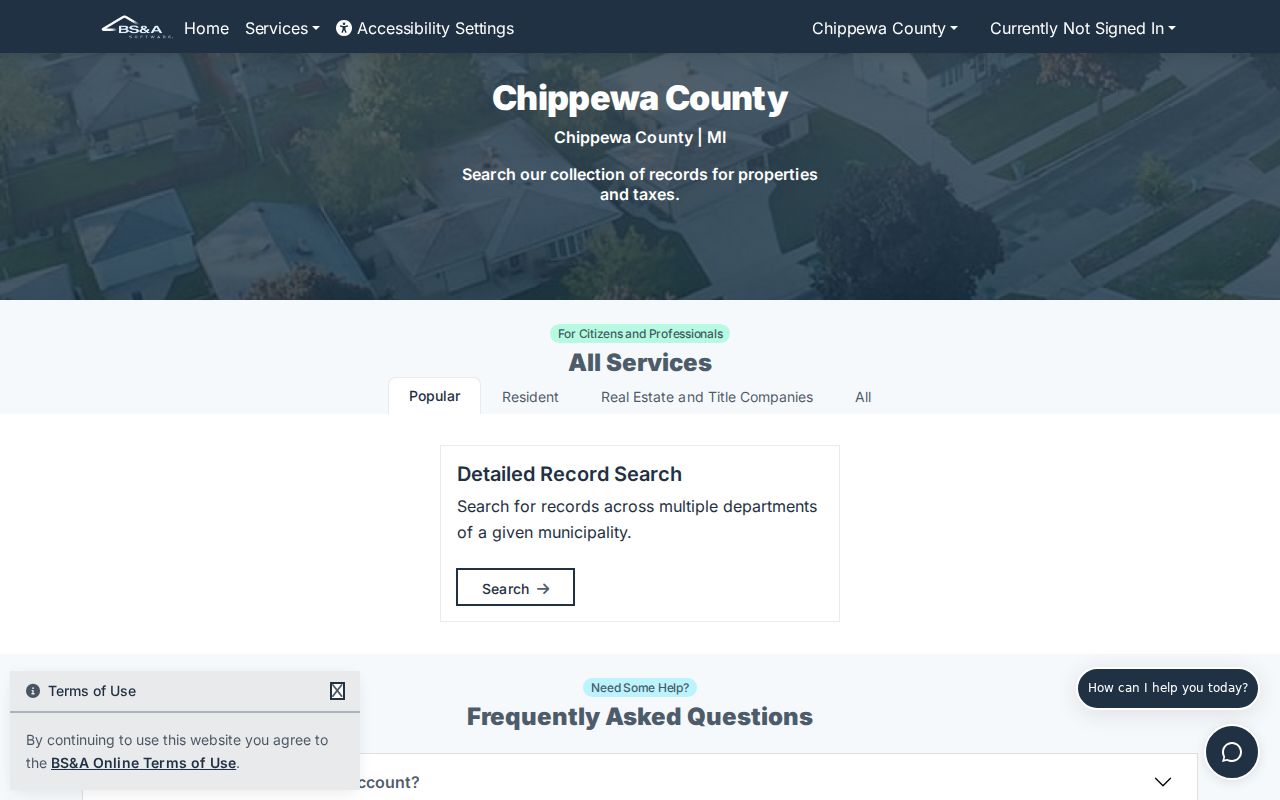
The portal itself shows the route without supplying a sample owner's identity. Enter a lawful property query instead. Then record the name label, tax year, PIN, and result date from the live card.
Compare Chippewa County Ownership Clocks
Chippewa County's assessment roll and deed index run on separate clocks. BS&A mirrors the assessor's tax roll. The Register of Deeds says a recorded instrument is generally indexed within two working days. LandWeb gets its refresh Monday morning. None of that promises the two screens change together. Time gaps matter most after a sale. A new deed can be recorded while the assessor card still carries the former owner, or the assessment office may still be processing a transfer before LandWeb posts the instrument. Note the dates before calling the sources conflicting. Then search the buyer as grantee, the seller as grantor, the parcel description, and the likely recording window. Two dated records usually settle which screen lags.
Note: A recent name mismatch calls for date checks and confirmation from the office, not a guess about which screen is newer.
Confirm Chippewa County's Current Owner
Verification comes down to the latest recorded conveyance. The Register of Deeds search instructions describe a free guest name index searchable by name, document number, or description. The working index can contain errors. When title matters, inspect the instrument itself or order a certified copy.
- Open the assessment card and copy the owner or taxpayer label, name, PIN, tax year, situs address, mailing address, and legal description.
- Search LandWeb for that name as grantee. Also search likely spelling variants and the legal-description terms when needed.
- Identify the newest deed that fits the same land. Compare its grantee, recording date, instrument type, and full legal description with the parcel card.
- If the sources differ, check for a recent transfer, estate, trust, entity, parcel split, or index delay. Ask the assessor and Register of Deeds to confirm their own records.
A deed image may cite an earlier instrument. It can also attach an exhibit; follow that reference when the short legal description does not establish that it is the same parcel.
Define Chippewa County Owner Terms
Words matter here. Precise terms keep a tax record from sounding more conclusive than it is, so use the source's own label first and then state exactly what you checked.
- Owner of record
- The person or entity shown by the relevant official ownership record, with the source and date named.
- Grantee
- The party receiving the interest described by a recorded deed or other conveyance.
- Vesting
- The wording in the instrument that states who receives the interest and how it is held.
- Taxpayer field
- The name carried in an assessment or tax system; it should not be silently relabeled as deed-proven title.
- Registered agent
- A state filing contact for a business entity, not proof that the agent owns the parcel.
Cite the parcel record and the newest matching instrument. A map popup, mailing line, business filing, or tax bill alone is not enough to support a current-owner conclusion.
Route Chippewa County Owner Checks
Location changes the assessment route in Chippewa County. County Equalization reviews city and township rolls for uniformity. It does not set individual assessments. A parcel inside Sault Ste. Marie deserves a cross-check against the city BS&A portal, which offers assessing, property-sale, building, tax, and special-assessment searches. Rural land takes one more step. Identify the city, township, or village assessor tied to the record.
A postal city is not always the tax jurisdiction. Rural addresses can carry Sault, Brimley, Rudyard, Pickford, Kinross, or another mailing place while the legal municipality differs. Record both. For Drummond Island or other remote land, a PIN with a township-range-section description may beat a street string.
Check Chippewa County Entity Owners
Entity owners need extra care. Copy the exact legal name and its suffix from the owner line. First confirm that entity as grantee in the matching deed. Only then use the Michigan LARA business-entity search. Pull its state filing and registration identifier from there.
A business filing may list a registered office or agent. That contact does not personally own the land. A name in a filing proves nothing by itself. Trusts need the same caution. Search the trustee or grantor names, and search the recorded trust instruments affecting the parcel. Private trust terms may stay off the public record. An estate transfer may need both a probate order and a later recorded deed. Before that, the ownership trail is not clear.
Reconcile Chippewa County Transfer Records
Michigan expects more than a deed when land changes hands. The county Equalization FAQ gives a new owner 45 days to file a Property Transfer Affidavit with the local assessor after a non-exempt transfer. That duty holds even when no deed reaches the recorder. Form 2766 gathers the details. It lists property address, municipality, transfer date, purchase price, transferor, transferee, PIN, mailing address, and transfer questions. It helps explain an assessment update. It never replaces the recorded deed.
Taxable value can uncap the year after a sale. A parcel card may look freshly updated for that reason alone. Title may have moved earlier. Keep four facts separate. Note the deed recording date, affidavit answers, the sale line, and the tax year. The county also cautions that a sale price by itself cannot set a new state equalized value. A sale price alone cannot set a new state equalized value either way.
Three-way check. Compare the assessed owner or taxpayer field, latest ROD grantee, and mailing or situs lines without merging their meanings.
Ask Chippewa County Owner Custodians
Online access is only one channel. Contact Equalization at 906-635-6304 about the county parcel-search route and the proper local assessor. For title records, the Chippewa County Register of Deeds is at 319 Court Street, Sault Ste. Marie, MI 49783, with phone 906-635-6312 and email ccrod@chippewacountymi.gov. The public counter is open Monday through Friday from 8:00 a.m. to 5:00 p.m.; vault access ends at 4:30 p.m.
The Register lists copies at $1 per page, certification at $5, and office searches at 50 cents per year with a $5 minimum. State the parcel's full legal description, names, and date range. For a record held by a non-court county body but not published, a written Michigan FOIA request may be used. It must describe the requested record well enough for the office to locate it.
Contact a Chippewa County Owner
A tax record's mailing address is the contact clue offices rely on for notices. It could be a post-office box, a business address, a trustee's address, or a home outside Michigan. A short, property-related letter works best. Name the parcel. Offer a safe reply method. Never assume the mailing address is the owner's home.
Michigan's Address Confidentiality Program can substitute a protected address, which is not the parcel's physical location and reveals nothing about where someone lives. Court, tax, and recorded-property files can carry their own confidentiality and redaction rules. Ask the custodian about any specific withheld field.
Lawful use. Current owner records support due diligence, boundary questions, and legitimate contact. Never use them to stalk, harass, threaten, or target a person.