
Start a Chippewa County Property Records Search
Match the source to the clue in hand. An address or parcel identification number fits the county BS&A parcel search. It also fits the Eastern Upper Peninsula FetchGIS map. A name, personal or company, fits the Register of Deeds LandWeb index. Compare what you find there against the assessment record. A disputed tax amount belongs to the local assessing unit and the County Treasurer. Older ownership questions may require deed books, plats, archives, or a focused written request. That applies once the online trail runs cold.
Keep each office's role distinct. The assessment roll gives an owner lead for one tax year. A recorded deed names the parties to a conveyance and carries the legal description. A GIS polygon locates land. It proves neither boundary nor title. The fuller Chippewa County property search guide explains the portal workflow in depth.
- Normalize the street address, municipality, ZIP code, and any unit, lot, or block reference.
- Use BS&A to capture the PIN, situs address, owner or taxpayer label, tax year, values, and legal-description text.
- Open FetchGIS by PIN, owner name, or street address and inspect the parcel with nearby map context.
- Search LandWeb by party name, document number, or description and read the latest relevant instrument.
- Confirm taxes, permits, zoning, or an official copy with the office that keeps that record.
Match Chippewa County Property Records to Their Custodian
Three county functions answer three questions. The Register of Deeds preserves recorded instruments. It also issues copies. Equalization reviews city and township assessment rolls for countywide uniformity. It never sets a parcel's individual assessment. The Treasurer takes delinquent real-property taxes, payments, and the foreclosure process. All three offices share the administrative address at 319 Court Street in Sault Ste. Marie, while parcel-level assessment disputes go to the local city or township assessor.
Register of Deeds
319 Court Street
Sault Ste. Marie, MI 49783
906-635-6312
Read Chippewa County Property Records in LandWeb
Guest access to LandWeb is free. The Register of Deeds documents searches by name, document number, and description. Recorded documents are generally indexed within two working days. The system updates Monday morning. That timing helps. Still, a very recent filing may not appear at once, so save the search date along with the FROM, TO, and DOWNLOAD dates the system displays.
| Search clue | Use in LandWeb | Check in the result |
|---|---|---|
| Party name | Try spelling variants, initials, and entity suffixes | Grantor or grantee role |
| Document number | Retrieve a known filing directly | Instrument type and recording date |
| Description | Use subdivision, lot, section, or other indexed terms | Match to the complete legal description |
The static instructions publish no full field list. They give no earliest online year either. Call the office when a search period or a field's behavior matters.
Get Chippewa County Deed Records at the Counter
The counter is another route. The Register of Deeds public counter is open Monday through Friday, 8:00 a.m. to 5:00 p.m., and the vault closes at 4:30 p.m. Copies cost $1 per page. Certification adds $5. Office research costs 50 cents for each year searched, with a $5 minimum. Online document copies carry a $5 transaction fee. Recording a document is listed at $30 regardless of page count, and special charges can apply for additional assigned or discharged instruments and certain warranty-clause certification.
A good written or phone request names the parties. For older material, certified copies, or index questions, contact 906-635-6312 or ccrod@chippewacountymi.gov, and include the approximate years, the parcel's legal description, and any known document references. The working index can contain errors. Check a screen result against the instrument image or an official copy. The county's own online searching instructions show the purchase route. They also flag the limits worth noting.
Use Two Clocks in Chippewa County Property Records
A recent sale runs on two clocks. The deed follows the Register of Deeds process. The assessor and tax record follow the local roll and transfer cycle. So a new deed can appear first. The owner or taxpayer field lags behind. A tax record may still show the prior cycle while a recorded conveyance is already public, so log the date and tax year of every result instead of trusting one display as timeless.
Michigan's Property Transfer Affidavit adds another dated source. County guidance says a nonexempt transfer generally requires filing with the local assessor within 45 days. The form asks for the address, transfer date and price, municipality, PIN, seller, buyer, financing and relationship information, exemptions, and a signature. It is not confidential. Keep the reported sale amount distinct from assessed value, SEV, and taxable value.
Key distinction. An assessor owner or taxpayer label is a current-roll lead; the most recent recorded deed is the better source for confirming the conveyance.
Choose the Chippewa County Property Record That Answers the Question
No single record tells the whole history. Recorded instruments show transfers and encumbrances. Assessment and tax data describe one parcel for a given cycle, mapping tools show spatial context, and municipal files document public land-use actions. Compare fields rather than merging them into one vague profile.
| Record Type | What It Documents | Kept By | Access |
|---|---|---|---|
| Deeds | Conveyance parties, recording data, legal description | Register of Deeds | Free index; paid copies |
| Mortgages and liens | Recorded loans, claims, assignments and releases | Register of Deeds | Free index; paid copies |
| Assessment and tax | Owner or taxpayer lead, values, status and tax data | Local assessor, Equalization, Treasurer | BS&A and office records |
| Plats and parcels | Lot, block, survey calls and approximate map context | Register of Deeds and EUP GIS | Index, copies and free viewer |
| Permits and zoning | Public approvals, inspections, variances and land-use files | Responsible municipality | Portal, document library or request |
A deed question belongs to the Register of Deeds. Instrument types and chain-of-title methods get fuller treatment in the Chippewa County deed records guide. Start a value question with the tax year and the local assessment record. A boundary concern begins with the full recorded description and may require a licensed surveyor.
Decode Chippewa County Property Records by Tax Year
The county BS&A portal shows property descriptions, taxable status, owner or taxpayer names, and mailing and situs addresses. It also shows tax information for Chippewa County parcels. Note the tax year attached to every field. Values, exemptions, and even ownership can shift from one year to the next. Export options, pagination, and the earliest year of coverage vary. Treat the screen as a window rather than a complete archive. When an older tax year is missing from the portal, ask the local assessor or the Equalization office. Do not guess.
True cash value is Michigan's usual-selling-price concept. State equalized value typically lands at half of true cash value once equalization is applied. Taxable value is where millage actually attaches. It moves under statutory caps until a transfer uncaps it. Sale price is simply a reported transaction amount, not an automatic assessment change.
County Equalization studies the city and township rolls across Chippewa County. It does not set each individual parcel assessment, though. Appeals and corrections start with the assessing unit named on the parcel record. That unit, not the county, holds the first authority over the number. County guidance also makes one point plain. An actual sale price alone cannot set a new SEV.
Map Chippewa County Property Records Without Assuming a Survey
The Eastern Upper Peninsula FetchGIS viewer spans Chippewa and Mackinac counties plus Sault Ste. Marie. Search modes include PIN, owner name, and street address. Parcel panels can open map, tax-history, land, sales, building, delinquency, and other report categories. Users can select parcels or graphics and set a buffer distance. They can also save a CSV and generate mailing labels. Those features are handy for spotting neighboring parcels in a Chippewa County property search. Still, verify any selected list against the official county records before relying on it. The map's own disclaimer states that its information is not a survey or legal description. It also comes without warranty. A parcel edge may be generalized or out of date. A split or combination may also alter it. The deed's full language matters more. Keep every lot, block, subdivision, township, range, section, exception, reservation, and easement reference intact. The Equalization FAQ notes the county may supply lot size or a plot map. It cannot locate boundary stakes. Note: When a current PIN fails in an older source, search the parent legal description, former parcel numbers, and subdivision name. Add the owner chain too.
Track Delinquency in Chippewa County Property Records
The County Treasurer handles delinquent real-property taxes in Chippewa County. Unpaid local taxes become delinquent at the county level. That happens on March 1 of the following year. Online tax access is currently free, though the retained years and on-screen controls may change. The office does not give tax information by email. Use the portal, phone, mail, or the counter instead. The payment page asks for the correct property ID and the amount due. It lists a 3 percent credit-card fee with a $3.99 minimum. There is also a $3.95 debit-card fee. The page warns that payments sent to the wrong parcel number are not refunded. Those charges are transaction facts, not evidence of value. The foreclosure page lays out an official timeline. It covers notice, title work, court judgment, and sale. A delinquent entry on a tax roll is not a completed foreclosure. Read the timeline before drawing conclusions.
The county foreclosure source shows where to check the formal process.
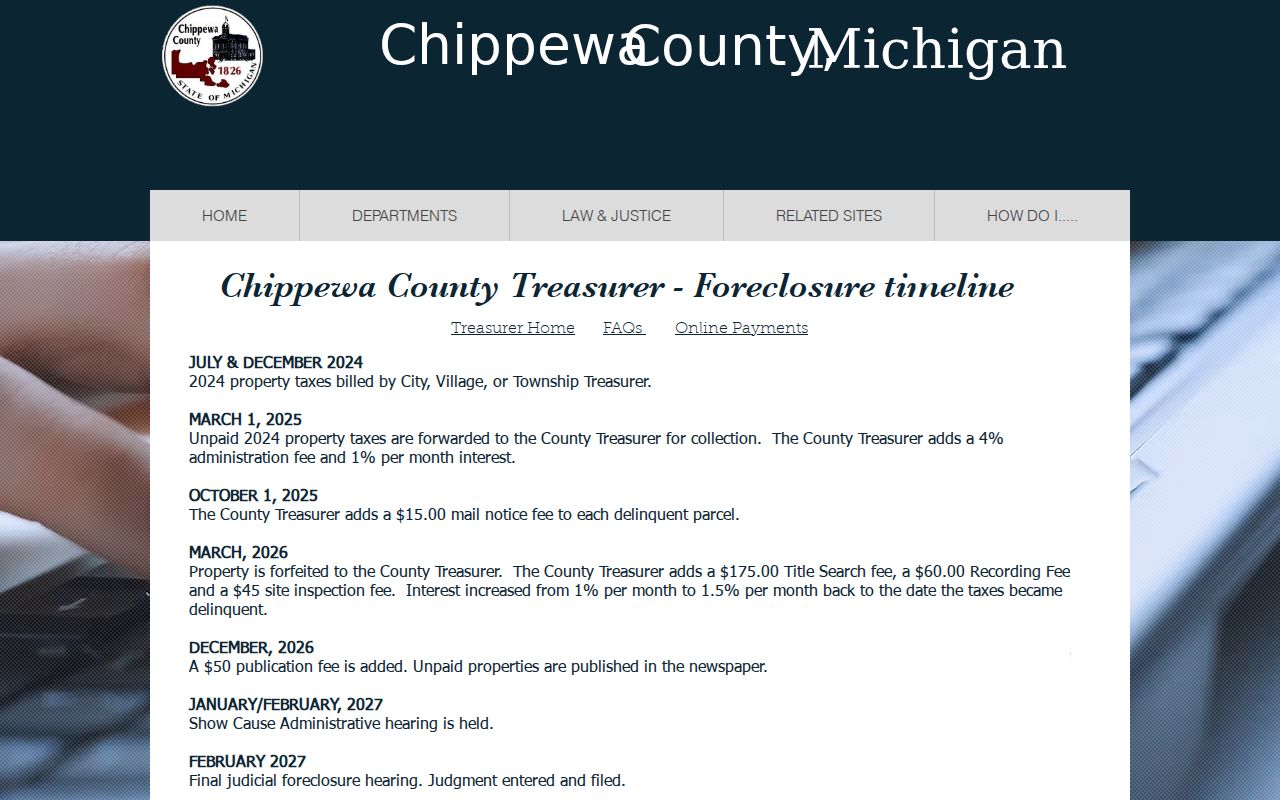
The page should be read with the parcel's current tax account and official notices.
Separate Sault Ste. Marie Records From Countywide Sources
Sault Ste. Marie is Chippewa County's only incorporated city. Its municipal records add a layer rather than replace county title records. City BS&A offers assessing, property-sales, building, current-tax, special-assessment, and detailed-record searches. The city GIS viewer layers in historical aerials, zoning, wetlands, and school districts. Voting precincts, roads, and natural features round out the map. Planning and Zoning, Ordinance Enforcement, and the Zoning Board of Appeals can each hold a distinct public file. Permits and the document library can hold more. A city address deserves a check in both city sources and the county's recorded-land records. Downtown, West Pier, the historic commercial district, former industrial areas, and waterfront land may demand extra attention. Plats, easements, old street references, and later land-use actions can all matter there. ZIP 49783 is postal context only. It does not prove a parcel sits inside the municipal boundary. The dedicated Sault Ste. Marie property records page follows that city-specific trail without duplicating the county office map.
Watch Address Changes in Chippewa County Property Records
A street address is a search key, not the lasting legal identity of land. Rural Chippewa County parcels may carry a postal city such as Sault Ste. Marie, Brimley, Rudyard, Pickford, Kinross, or Drummond Island. But the tax and legal jurisdiction belongs to a township or village. Situs and mailing addresses can differ too. Preserve both labels rather than silently forcing one to match the other. Parcel numbers change when land splits or combines. If a current PIN fails to reach an older record, follow the legal description into prior deeds. Trace the owner chain, and hunt for a parent parcel or subdivision lot. Township, range, and section calls shine in rural and historical work. Island and waterfront parcels can carry access easements, shore descriptions, government-survey calls, or rights that no colored polygon displays. Note: Normalize spelling and postal form for searching, but quote the instrument's legal description exactly when documenting a match.
Reach Older Chippewa County Property Records Beyond the Portal
The Register of Deeds office keeps over 150 years of recordings. The public instructions never state LandWeb's earliest online year. When your backward deed chain stops, visit the counter and vault in person. Then broaden the hunt by township, range, section, subdivision, prior owner, or deed-book reference. Recorded holdings include deeds, land patents, mortgages, liens, probate orders, land contracts, surveys, plats, and government corners.
Older paper runs deeper than one office. The Archives of Michigan county guide lists land, tax, court, and naturalization series for Chippewa County. The Library of Michigan guide points to plat books, newspapers, census material, cemetery records, and church sources. The County Clerk's genealogy room offers free viewing during limited Tuesday through Thursday sessions. Certified copies are listed at $10. Cameras and cell phones are not allowed there. These historical sources explain names and land context well. Yet they cannot replace the current deed and parcel record.
Recent county finance material mentions survey remonumentation and possible scanning of historic survey records. Completion and public availability remain unconfirmed. Call the Register of Deeds before counting on a digital collection.
Request Missing Chippewa County Public Records Precisely
Not every county record sits online. Michigan's Freedom of Information Act opens a written-request route for county and municipal administrative records. Describe the parcel, record type, date range, department, known names, and preferred delivery. Give them enough detail to find it. A response generally comes within five business days. A ten-business-day extension is allowed. Search, review, separation, copying, and mailing fees can apply under the law and the body's policy.
FOIA does not cover everything. Deeds and certified copies follow Register of Deeds rules. Court files follow the Clerk and court process, since Michigan's judiciary sits outside FOIA. For a 50th Circuit Court document, specify civil or criminal, file number, names, record and date, regular or certified copy, and requester contact details. Regular court copies run $1 per page. Certified copies cost $10 for the first page plus $1 for each added page.
Keep each request narrow and source-specific. "All records about this property" works far worse than a named permit file, assessment card, zoning decision, or recorded instrument within known dates.
Know the Limits of Chippewa County Property Records
Every official source proves something specific. An instrument shows parties and legal text for a stated date. An assessment roll labels owner or taxpayer. A Treasurer record shows tax status. GIS places a parcel only approximately. The records do not all establish the same fact about a parcel. A mailing address does not establish occupancy, and a ZIP code does not set jurisdiction. An assessment class does not establish zoning either. No permit, complaint, business filing, voter record, or public-safety database proves title.
A defensible summary cites the custodian, exact URL, search date, query, tax year or date window, field labels, and any disclaimer. When sources conflict, compare effective dates and ask the keeper of the controlling record. Commercial compiled data may be stale or blend people with similar names, so treat it as an unverified lead, never a substitute for the deed, roll, or certified copy.
Lawful use. Use Chippewa County property records for legitimate land research, transaction diligence, tax review, boundary work, house history, or civic transparency. A search is not a title opinion or survey, and owner information must never be used to stalk, harass, or harm anyone.